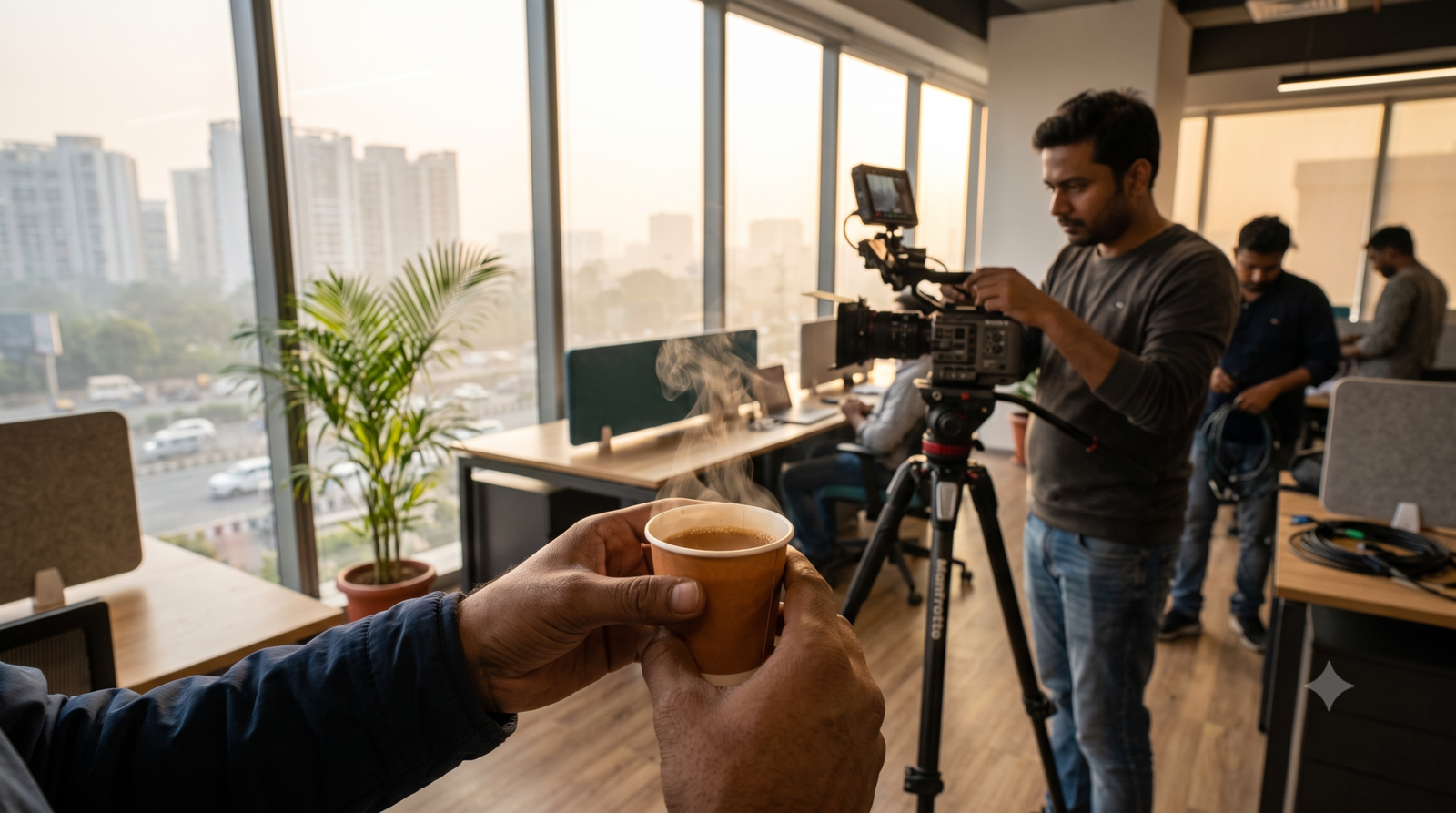
On the ground in India, pre-production meets physical reality.
When foreign agencies, global brand teams, or creative directors plan a shoot from thousands of miles away, they build specs based on studio assumptions or scout photos that never tell the full story. The day the gear cases pop open, the environment dictates terms. The true value of a technical line producer isn’t stubbornly enforcing the paper manifest—it is diagnosing the gap between expectation and reality, and pivoting technical kits instantly without stalling the day.
1. Optics vs. Architecture: When the Zoom Hits the Wall
- The Paper Plan: The brief demands heavy cine zooms to cover wide perspectives and tight punch-ins without swapping lenses.
- The Ground Reality: The location is a compact, operational tech incubator or a low-ceiling executive suite. The zoom’s minimum focus distance and physical bulk crowd the room, while its wide-open aperture flattens the background into a blurry wash that offers zero environmental context.
- The Pivot: Swapping instantly to fast prime or block lenses. A 35mm or 50mm prime with greater controlled depth of field and a tighter physical footprint restores the architectural texture behind the subject, letting the space breathe while fitting into tight corners.
2. The Power Grid Trap: Hybrid Cameras vs. Mains Frequency
- The Paper Plan: Deploying ultra-compact hybrid mirrorless bodies to stay minimal and fly under the radar.
- The Ground Reality: The location draws power from unstable grid lines or mixed generator setups driving dirty LED ballast fixtures. Severe rolling-shutter banding and persistent flicker appear across the frame.
- The Pivot: Consumer or lower-tier hybrid bodies often lack fractional shutter angle adjustments or global shutter readouts capable of dialing out localized frequency phasing. Resolving this requires immediate access to dedicated cinema cameras equipped with true fractional shutter angles (e.g., $172.8^\circ$ or $144^\circ$) and variable frequency phase tuning to eradicate banding before the record button is pressed.
3. The Audio Acoustic Trap: Booms vs. Unconditioned Glass Boxes
- The Paper Plan: High-end shotgun microphones boomed overhead to keep the talent clean and free of visible lavaliers.
- The Ground Reality: The client chooses a high-rise conference room encased in untreated parallel glass and concrete, with a commercial HVAC system that cannot be deactivated. The boom mic turns into an echo chamber of ambient reflections.
- The Pivot: Bypassing the boom entirely in favor of dual-redundant micro-lavaliers hidden inside clothing collars, paired with low-profile boundary boundary mics planted on the desk to isolate direct vocal resonance against reflective surfaces.
4. The Daylight Shift: High-Draw HMIs vs. Agile Bi-Color LEDs
- The Paper Plan: Big-budget punch: 4K/9K HMIs specified to blast fake daylight through third-story windows.
- The Ground Reality: The building management denies exterior balcony rigging, or local electrical distribution can’t handle the draw without tripping circuits for the entire office floor.
- The Pivot: Swapping heavy metal-halide units for high-output, battery-operable COB LEDs equipped with spotlight mounts and lightweight diffusion frames. You match daylight output with a fraction of the power footprint and zero rigging delays.
5. Call Sheet Expansions: Scaling the Floor Unit on Demand
- The Paper Plan: A single operator moving sequentially through interviews and workplace B-roll.
- The Ground Reality: The client realizes midway through the morning that executive availability has compressed from two days into three hours. Multiple interviews now must happen simultaneously across different wings of the building.
- The Pivot: An agile production network allows the line producer to tap a local, vetted talent pool within the city to mobilize a secondary camera operator, an audio recordist, and a duplicate kit to run parallel setups, preventing creative loss without ballooning long-term overhead.
The Rule of Technical Redundancy
Adapting to on-set variance requires two fundamental principles:
- Gear Agnosticism Over Kit Pride: Never lock a shoot into an inflexible personal camera package. Working with top-tier, localized rental houses ensures that if an optical, electrical, or space conflict emerges, a replacement body, specialized lens set, or lighting head is dispatched and on set within the hour.
- Technical Diagnosis Over Panic: When an image breaks or power surges, an operator who understands circuit loads, sensor readout speeds, and optical physics solves the issue at the source instead of debating whose fault the spec was.
A successful Indian production isn’t measured by how closely the set mirrored the pre-production PDF. It is measured by the producer’s ability to turn on-location chaos into broadcast-grade imagery without the home office ever feeling the friction.
Contact